Chart to explore
Temperature in Bahariya Oasis, month by month
Light and heat through the year
Twelve months at Bahariya Oasis
Choose a month to compare sunset, day length and the usual warmth at the BAHARIA station, then read what it means for a desert camp.
Sunset
Jan
- Sunset close to 17:29
- Daylight lasts about 10.5 h1
- For a camp night: Cold nights, mild days1
- Days roughly 20°C, nights roughly 8°C1
The average low is 7.5 °C, and the draft plan puts the average minimum below zero in the area.1,4
Feb
- Sunset close to 17:54
- Daylight lasts about 11.2 h1
- For a camp night: Cold nights, mild days1
- Days roughly 21°C, nights roughly 8°C1
Highs average 20.9 °C and lows 7.8 °C, so keep the warm layer for the evening.1
Mar
- Sunset close to 18:13
- Daylight lasts about 12 h1
- For a camp night: Mild, cool nights1
- Days roughly 24°C, nights roughly 10°C1
The first noticeable change, with a high of 23.6 °C and a low of 10.2 °C.1
Apr
- Sunset close to 19:29
- Daylight lasts about 12.8 h1
- For a camp night: Warm days, cool nights1
- Days roughly 30°C, nights roughly 14°C1
A high of 29.5 °C by day and 14.3 °C at night, so pack for both ends.1
May
- Sunset close to 19:47
- Daylight lasts about 13.5 h1
- For a camp night: Hot days, mild nights1
- Days roughly 34°C, nights roughly 18°C1
Highs reach 34 °C and the days are long, so start with shade and water.1
Jun
- Sunset close to 20:03
- Daylight lasts about 13.9 h1
- For a camp night: Very hot days1
- Days roughly 36°C, nights roughly 21°C1
The sun is above the horizon for 13.9 hrs, with a high of 36.3 °C.1
Jul
- Sunset close to 20:04
- Daylight lasts about 13.8 h1
- For a camp night: The hottest month1
- Days roughly 37°C, nights roughly 23°C1
The hottest month, averaging 37.3 °C, and the Tourism Authority says summer can reach 35 to 45 °C.1,2
Aug
- Sunset close to 19:45
- Daylight lasts about 13.2 h1
- For a camp night: The hottest month1
- Days roughly 37°C, nights roughly 23°C1
Almost as hot as July, at 37.1 °C by day and 22.7 °C at night.1
Sep
- Sunset close to 19:11
- Daylight lasts about 12.4 h1
- For a camp night: Hot days, warm nights1
- Days roughly 35°C, nights roughly 21°C1
Highs of 35.3 °C and lows of 21.3 °C, still a hot month.1
Oct
- Sunset close to 18:36
- Daylight lasts about 11.5 h1
- For a camp night: Warm days, mild nights1
- Days roughly 30°C, nights roughly 18°C1
A high of 30.5 °C and a low of 17.5 °C, a balanced month for a camp.1
Nov
- Sunset close to 17:12
- Daylight lasts about 10.8 h1
- For a camp night: Mild days, cool nights1
- Days roughly 25°C, nights roughly 12°C1
Highs of 24.7 °C and lows of 12.2 °C, with the days growing short.1
Dec
- Sunset close to 17:10
- Daylight lasts about 10.4 h1
- For a camp night: Cool days, cold nights1
- Days roughly 20°C, nights roughly 7°C1
A high of 20.3 °C and a low of 7.4 °C, so bring warm clothes for the night.1
Sunset is worked out for the 15th of each month on Cairo time, with summer time from late April to late October. Day length and temperatures: NOAA averages for the BAHARIA station near Bawiti, 1991 to 2020, temperatures only, so there are no rain figures.
Mild winter days and cold nights, a hot summer and short transitions in between. Use the figures to pick the month that suits your camp night in the White Desert.
Editorial team, bahariyaoasis.quest · Updated November 23, 2026 · Reading: 7 min
The essentials
- Coolest monthJanuary averages a high of 20.1 °C and a low of 7.5 °C.1
- Hottest monthJuly averages a high of 37.3 °C and a low of 22.7 °C.1
- Summer peaksThe Tourism Authority says temperatures can reach 35 to 45 °C.2
- Spring and autumnApril averages 29.5 °C by day, October 30.5 °C.1,1
- RainThe draft plan for the White Desert area gives 0 to 15 mm a year.3
What the Bahariya numbers say
People who look up the meteo for Bahariya Oasis, or the temperature in Bahariya Oasis, usually want to know two things: whether the days are comfortable and whether the nights are cold. The figures below come from NOAA's BAHARIA station, an averaged record from 1991 to 2020 near Bawiti.1 This station records temperatures only, so the file carries no rainfall rows, and the page says nothing about rain from it.
Read the numbers as averages, not guarantees. A day can run several degrees above or below the monthly mean, and a camp in open desert, far from the village, tends to cool faster at night. The Egyptian Tourism Authority adds a wider summer range, with peaks of 35 to 45 °C in Bahariya.2 That gap between an average and a peak matters for planning.
The data show broad seasons: a mild winter with cold nights, a hot summer with warm nights and short shoulder periods in spring and autumn. The sections below take them in order, and the table and chart that follow let you compare months at a glance. At the end the page turns the numbers into a short, practical choice of month.
Two months at a time
Highs, lows and daylight across the year
| Months | Average highs | Average lows | Daylight |
|---|---|---|---|
| Jan and Feb | 20.1 and 20.9 °C1,1 | 7.5 and 7.8 °C1,1 | 10.5 and 11.2 hrs1,1 |
| Mar and Apr | 23.6 and 29.5 °C1,1 | 10.2 and 14.3 °C1,1 | 12 and 12.8 hrs1,1 |
| May and Jun | 34 and 36.3 °C1,1 | 18.5 and 20.9 °C1,1 | 13.5 and 13.9 hrs1,1 |
| Jul and Aug | 37.3 and 37.1 °C1,1 | 22.7 and 22.7 °C1,1 | 13.8 and 13.2 hrs1,1 |
| Sep and Oct | 35.3 and 30.5 °C1,1 | 21.3 and 17.5 °C1,1 | 12.4 and 11.5 hrs1,1 |
| Nov and Dec | 24.7 and 20.3 °C1,1 | 12.2 and 7.4 °C1,1 | 10.8 and 10.4 hrs1,1 |
Averages for the BAHARIA station near Bawiti, temperatures only; daylight is sun above the horizon at mid-month.1
Winter: mild days and cold nights
The coolest months are December, January and February. In January the average high is 20.1 °C and the average low is 7.5 °C,1 while February averages 20.9 °C by day and 7.8 °C at night.1 December is almost the same, with 20.3 °C and 7.4 °C.1 Those are comfortable days for walking and photographing, and cold nights for sitting by a fire.
A draft management plan for the park calls winter nights very cold, with an average minimum under zero.4 That is a different place from the Bawiti station, so use it as a warning rather than a forecast. Pack accordingly for a camp, as the packing guide on this site explains. A cold night can turn a clear sky into a highlight, with stars that need no help from a telescope.
Days are short in winter. Mid-December has 10.4 hrs of sun above the horizon, and mid-January has 10.5 hrs.1,1 A tour that reaches the White Desert for sunset in winter has little spare daylight, so ask your operator about the order of stops. The upside is that low light flatters the chalk and the dark hills, and the walking is easy.
Spring and autumn: the in-between months
March is the first month with a noticeable change, with an average high of 23.6 °C and a low of 10.2 °C.1 April climbs to 29.5 °C by day and 14.3 °C at night.1 November is the mirror image, with 24.7 °C by day and 12.2 °C at night,1 and October sits at 30.5 °C and 17.5 °C.1 These months suit a traveller who wants warm days and cool evenings.
Because nights stay cool but not freezing, a spring or autumn camp asks for layers more than heavy clothing. A light fleece and a windbreaker will do for most evenings, with a sun hat for the day. Midday can still feel hot in April and October, so plan stops that give shade, and drink water regularly even if the air feels pleasant.
The day length shifts quickly in these months. In mid-March the sun is above the horizon for 12 hrs, and in mid-April for 12.8 hrs.1,1 In mid-October it is 11.5 hrs, and in mid-November 10.8 hrs.1,1 That swing changes when the sunset happens, which matters if you want the pink chalk at the end of a long drive.
Choose a month
Which season fits you?
Name what you want from the trip and the months to look at first appear below.
If I want comfortable walking
December to February
January and February average highs of 20.1 °C and 20.9 °C.1,1
If I feel the cold at night
Pick a warmer month
July and August lows average 22.7 °C, against 7.5 °C in January.1,1,1
If I want long daylight
June or July
If I want warm days and mild nights
March, April, October or November
April averages 29.5 °C and 14.3 °C; November 24.7 °C and 12.2 °C.1,1
If I cannot take the heat
Avoid the summer peak
The Tourism Authority says summer can reach 35 to 45 °C.2
Summer: the heat of the oasis
From May the averages climb. May has a high of 34 °C and a low of 18.5 °C,1 June 36.3 °C and 20.9 °C,1 and July 37.3 °C and 22.7 °C.1 August is almost as hot at 37.1 °C and 22.7 °C,1 and September stays at 35.3 °C and 21.3 °C.1 The warmest nights of the year are in July and August, and the cooling after sunset is slower than in the other seasons. Treat the hottest weeks as a time for shade, rest and patience, not for long walks.
In the Tourism Authority's words, Bahariya can see 35 to 45 °C in summer.2 The park's draft plan calls summer days very hot.5 In this heat, early starts, shade, a hat and plenty of water are not optional. Ask your operator how the day is paced, and avoid long walks between late morning and mid-afternoon.
The Ministry of Tourism and Antiquities notes that the oasis has hot springs with healing properties, which suit a visit in the cooler months.7 A summer camp night can still be pleasant, since the desert cools after dark, but the nights are warmer than in winter. Long daylight in June gives 13.9 hrs of sun above the horizon,1 which gives a late sunset and an early dawn for photographs.
A winter camp day
A January day in the White Desert, hour by hour
Morning
Cool start
Expect cold air at first, with a high of 20.1 °C later in the day.1
Midday
Mild sun
A hat and sunglasses are enough, and layers come off.
Late afternoon
Light drops
Day length is 10.5 hrs, so sunset comes early.1
Evening
Fire and tea
The temperature falls towards the average low of 7.5 °C.1
Night
Cold sky
The draft plan gives an average minimum below zero in the area.4
Dawn
Tent breakfast
The second day begins with breakfast at the campsite.
Nights in the camp
A camp changes the question from the day's high to the night's low, and a Bahariya Oasis night in the desert is a different thing from a night in town. The lows run from 7.4 °C in December and 7.5 °C in January up to 22.7 °C in July and August.1,1,1,1 That is a wide swing between the coldest and warmest nights, and the bag you pack for January will not suit July at all. Plan around the month of your tour and check the forecast a few days before you leave, since a camp night depends more on the evening than on the afternoon.
Tents are where guests sleep, and the camp has no toilet facility. In winter, thicker bedding and warm clothing matter. In summer, a light layer is enough once the sun is down, and the tent can feel stuffy at dusk. Ask the operator what bedding is supplied, because the record names none.
The draft plan adds that red foxes come close to camps at night, which is one more reason to keep food sealed.8 A quiet evening by the fire, with the temperature falling, is the main pleasure of a camp night. Whatever the month, wait for the sky to darken before you decide you are cold, and add a layer before you feel it, because getting cold is easier than getting warm again.
Video
An overnight 4WD camping trip into the Black and White Deserts
Pursue The Adventure on YouTube · Nothing is fetched until you hit play.
The temperature regime summer is very hot in the day and very low at night in winter.
By season
What to do about the temperature
Winter trip3
Summer trip3
Any month3
- Check dates and free cancellation
- Carry travel insurance, as the listing recommends
- Use lip balm for dry air6
Rain, humidity and wind
The BAHARIA record used here has no rainfall rows, so this page does not give a monthly rain figure for Bawiti. For the wider White Desert area the environment agency's draft plan says rainfall is very rare, generally 0 to 15 mm a year.3 Rain is not what to plan around, though a sudden shower can happen on any trip, and tracks can change after one.
Relative humidity in that plan runs from 5 % in winter up to 56 % in summer.6 Very dry air means your skin, lips and eyes dry out quickly. Bring lip balm and moisturiser, and drink more water than feels necessary. Dry air also means that the heat of a summer day can feel less oppressive than a humid coast, which hides how much you lose through sweat.
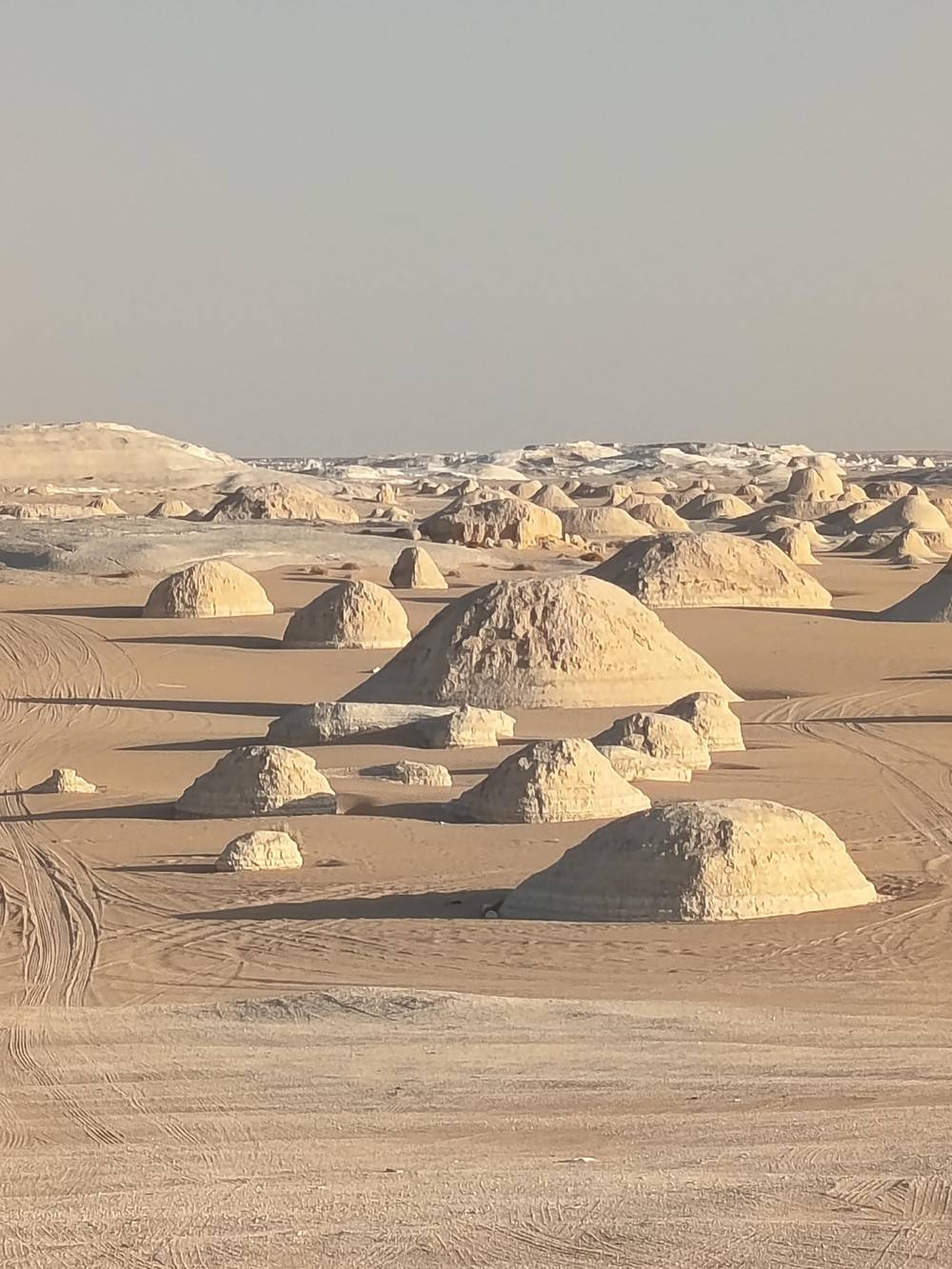
Wind is part of the scenery. The draft plan links the pitted, polished look of the chalk stacks to the wind.9 A buff or scarf is useful for gusty days, and sunglasses with a close fit protect your eyes from sand. If you go sandboarding, which the Ministry lists as a White Desert pick, wear clothes that can take a little sand.10
Choosing your month
If you want comfortable walking, December to March has mild days, though the nights are cold. If you want a mix of warm days and gentler nights, March, April, October and November are the in-between months. If you accept the heat for the sake of warm nights and long daylight, June to August offers them. No month is perfect, and each one suits a different traveller.
Whichever month you choose, check the tour dates and the group size. The camp tour that leaves from Cairo or Giza is a small group of up to 13 participants, and the shared tour runs only with 2 people at least. If too few people book, the operator can cancel or move a shared departure, so keep your plans flexible in the shoulder months.
A place costs from $206, you pay nothing today if you reserve now, and the free cancellation window closes a day before the start. That leaves time to watch the outlook for your dates before you commit. Pack for the temperatures on this page, tell your guide about any health condition, and allow a little extra water, whatever the month.
FAQ
Fast answers to common questions.
What is the temperature in Bahariya Oasis in winter?
January averages a high of 20.1 °C and a low of 7.5 °C at the BAHARIA station.1
How hot does Bahariya Oasis get in summer?
How cold are the nights in the White Desert?
The plan's average minimum for the area is under zero.4
Which months have the mildest days?
Does it rain in Bahariya Oasis?
The draft plan says rainfall is generally 0 to 15 mm a year.3
How much daylight is there in June?
Mid-June has 13.9 hrs of sun above the horizon at the station.1
Is the tour held in summer?
Starting times appear at booking, and cancellation is free until a day before the start.
Sources
- NOAA · Global Summary of the Month, Station Baharia (NOAA GHCN EG000624200), 1991 to 2020 ↩
- Egyptian Tourism Authority (Wayback copy, 2023) · Bahariya Oasis ↩
- Egyptian Environmental Affairs Agency (EEAA) · White Desert Protected Area management plan, draft 2007 (PDF) ↩
- Egyptian Environmental Affairs Agency (EEAA) · White Desert Protected Area management plan, draft 2007 (PDF) ↩
- Egyptian Environmental Affairs Agency (EEAA) · White Desert Protected Area management plan, draft 2007 (PDF) ↩
- Egyptian Environmental Affairs Agency (EEAA) · White Desert Protected Area management plan, draft 2007 (PDF) ↩
- Egyptian Ministry of Tourism and Antiquities (Experience Egypt) · Al-Bahariyya Oasis ↩
- Egyptian Environmental Affairs Agency (EEAA) · White Desert Protected Area management plan, draft 2007 (PDF) ↩
- Egyptian Environmental Affairs Agency (EEAA) · White Desert Protected Area management plan, draft 2007 (PDF) ↩
- Egyptian Ministry of Tourism and Antiquities (Experience Egypt) · Al-Bahariyya Oasis ↩